
Generative Art Timeline · Chapter 3: Analog Era (1950s)
1951
John von Neumann Devises Cellular Automata
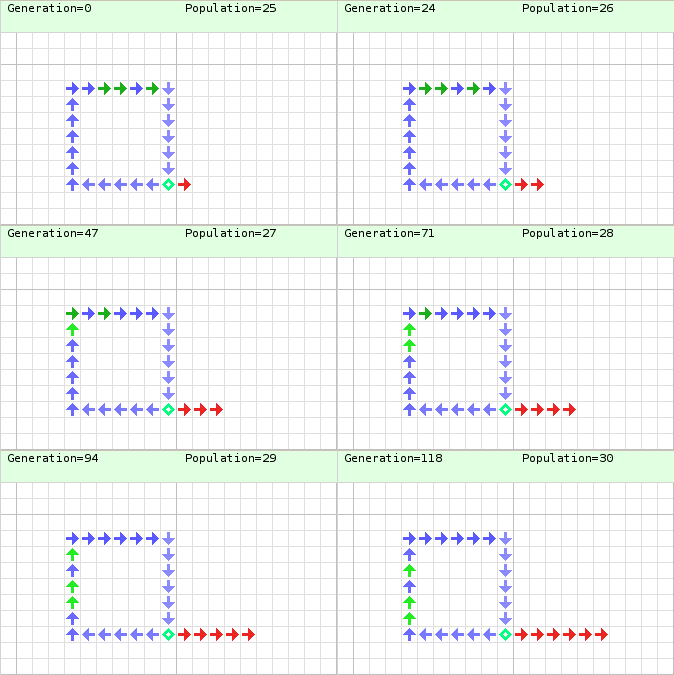
The Hungarian-American mathematician von Neumann’s conception of cellular automata (CA), suggested by Stanislaw Ulam, demonstrated the potential for simple rules to give rise to complex and unpredictable behavior. CA has been foundational to the development of generative art as CA profoundly influenced fields such as artificial life, complexity science, and computer graphics.
Text by Peter Bauman. Generative Art Timeline, Le Random.
Sources
People
John von Neumann, Stanislaw Ulam
Movements
artificial life, generative art
Filed under
- Ideas
- artificial life, complexity, emergence, generative art, rules
- Technologies
- cellular automata, computer graphics
- People
- John von Neumann, Stanislaw Ulam
- Places
- United States
Echoes across time
- 1970 · Martin Gardner Publishes John Conway’s Game of Life in Scientific American
- 1986 · Langton’s Ant
- 2010 · Characteristics of pattern formation by Jeff Jones
Related moments
Le Random editorials
- Demystifying Generative Systems, Peter Bauman, June 20, 2024
- Demystifying Generative Art, Peter Bauman, July 20, 2023
Le Random podcast
- Celebrating Genuary with Piter Pasma — listen with transcript on Le Random (03 Feb 2024, 53 min). Transcript mentions cellular automata. Apple Podcasts · Spotify
- Recapping Digital Art in 2Q 2025 — listen with transcript on Le Random (29 Jun 2025, 56 min). Transcript mentions cellular automata. Apple Podcasts · Spotify
- Timeline Ch 3—Analog Era (1950s) with Georg Bak — listen with transcript on Le Random (10 Aug 2023, 65 min). Chapter 3’s episode. Apple Podcasts · Spotify