
Generative Art Timeline · Chapter 2: Modern Era (1850–1949)
1912
Nude Descending a Staircase, No. 2 by Marcel Duchamp
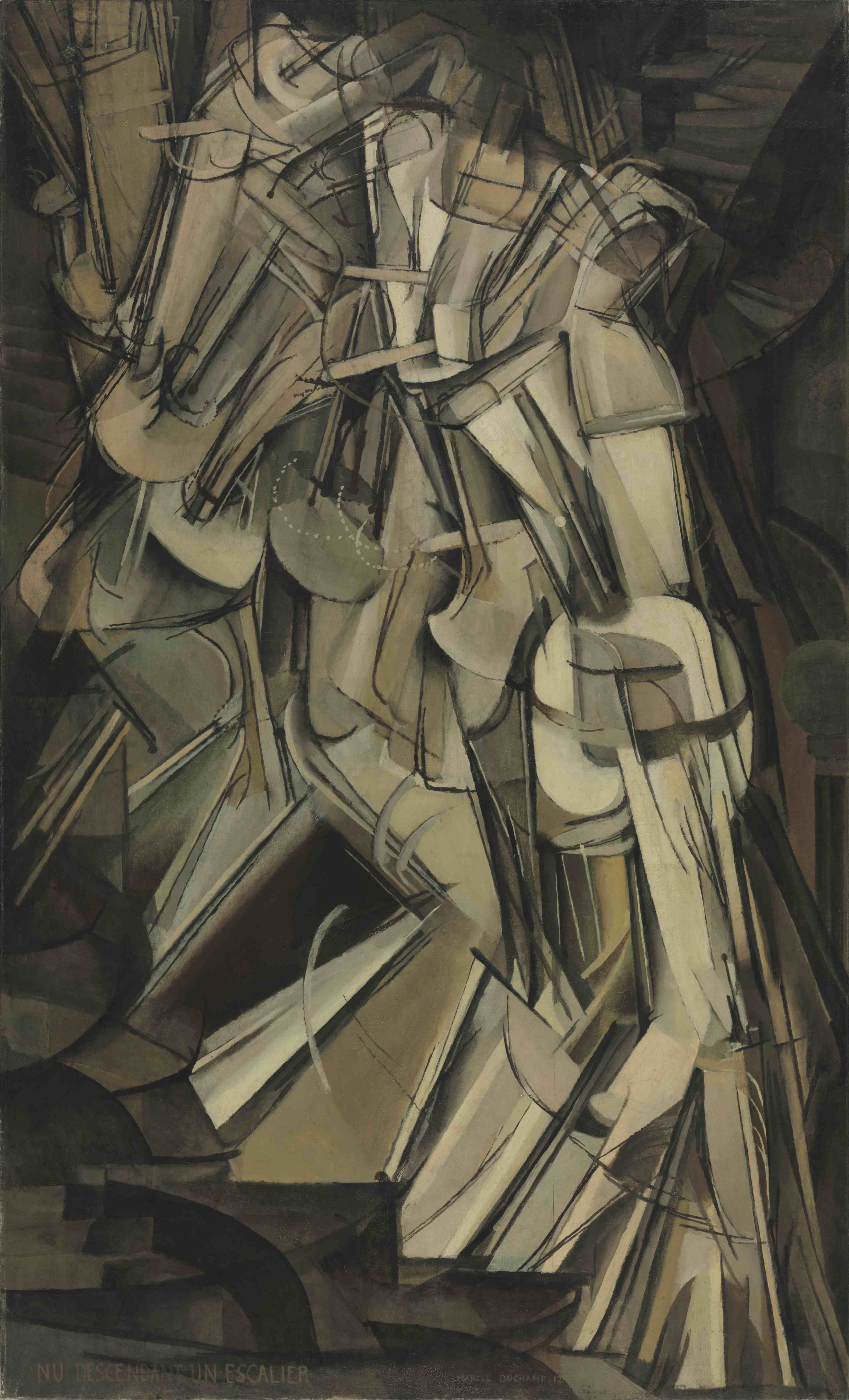
Rejected by the Cubists for appearing too Futurist, this proto-Dadaist painting applies a machine aesthetic to the human form, anticipating the dynamism of Kinetic Art that led to electronic art. Duchamp called this series of paintings “an organization of kinetic elements - an expression of time and space through the abstract presentation of movement…[But] we must bear in mind that, when we consider the movement of form in space over a certain time, we are entering the realm of geometry and mathematics in the same way as when we construct a machine.” Geometry, movement, mathematics, Duchamp’s massive impact on art history includes profoundly anticipating digital generative art well.
Text by Peter Bauman. Generative Art Timeline, Le Random.
Sources
- Popper, Frank. Art of the Electronic Age, 12. New York: Thames and Hudson, 1997.
People
Movements
Cubism, Dadaism, Futurism, Lumino-Kinetic Art
Filed under
- Ideas
- Cubism, Dadaism, Futurism, geometry, Lumino-Kinetic Art, machine aesthetic, mathematics, movement, space, time, Electronic Art
- Technologies
- kinetic art
- People
- Marcel Duchamp
- Works
- Nude Descending a Staircase, No. 2
Echoes across time
- 1968 · "On the Path to Computer Art” by the Parallel Group
- 1970 · Generación Automática de Formas Plásticas Exhibition at the Centro de Cálculo of the University of Madrid
- 1969 · Computerkunst - On the Eve of Tomorrow Exhibition in Hannover
Related moments
Le Random editorials
- What Was the AI Psychosis Summit?, Kevin Esherick, July 27, 2026
- Demystifying Generative Systems, Peter Bauman, June 20, 2024
- Mona Lisa to monogrid, Peter Bauman, March 6, 2024
- New York City Digital Art Guide, LoVid, Emily Edelman, Josh Yakov, Peter Bauman, May 5, 2025
Le Random podcast
- Timeline Ch 2—Modern Era with Kate Vass — listen with transcript on Le Random (20 Jul 2023, 58 min). Transcript mentions Marcel Duchamp. Chapter 2’s episode. Apple Podcasts · Spotify
- Timeline Ch 9—AI Era (2010s) with Tyler Hobbs, Helena Sarin, Rhea Myers & Gene Kogan — listen with transcript on Le Random (30 Jul 2024, 51 min). Transcript mentions Marcel Duchamp. Apple Podcasts · Spotify
- Timeline Ch 10—On-Chain Era (2020s) with Erick Calderon, Lauren Lee McCarthy, Itzel Yard & Rafael Lozano-Hemmer — listen with transcript on Le Random (02 Sep 2024, 63 min). Transcript mentions Marcel Duchamp. Apple Podcasts · Spotify